
1. Purpose
RI-001 defines the institutional boundaries of the Responsibility Infrastructure framework. RI-002 establishes the principles through which responsibility becomes provable. This publication defines the core architectural components required to implement those principles within a functioning Responsibility Infrastructure environment.
This document functions as the canonical architecture publication of the framework. Future standards, registries, conformity assessments, certifications, software implementations, and operational frameworks derive their structural vocabulary from the architectural primitives defined herein.
If any architectural component defined within this publication is absent, the ability to establish, preserve, verify, transfer, or reconstruct responsibility may become impaired.
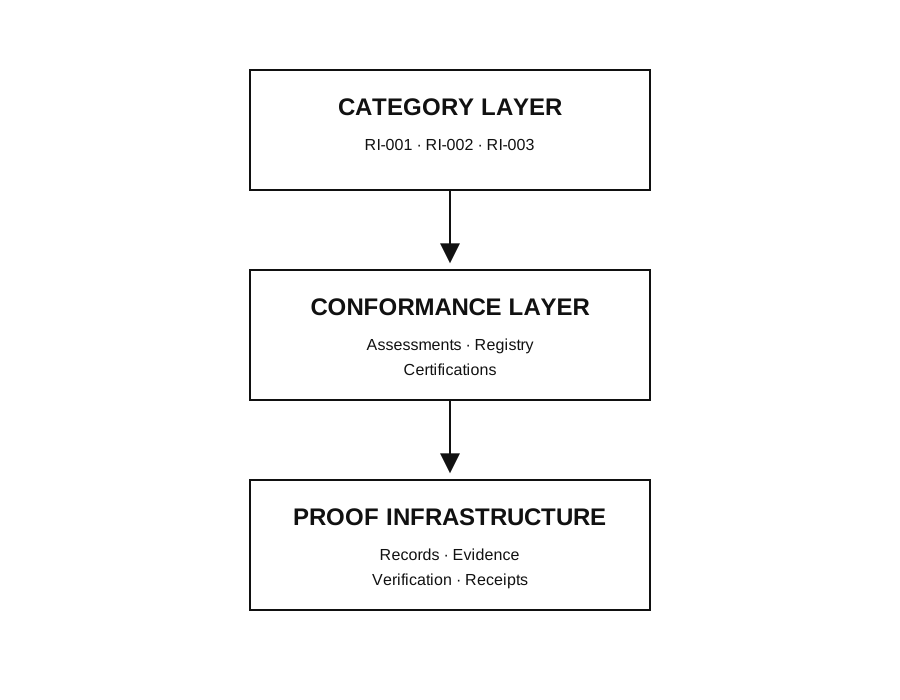
2. Architecture Layer Mapping
The architectural components defined in this publication operate at the framework layer of Responsibility Infrastructure. They establish the structural model against which operational systems, registry environments, verification frameworks, and proof infrastructures may be evaluated.
3. Architectural Building Blocks
Responsibility Infrastructure requires the following architectural components. Together these components form the minimum structural architecture necessary to establish, preserve, verify, transfer, and reconstruct responsibility.
3.1 Responsibility Governance
Responsibility Governance establishes oversight, stewardship, review, escalation, amendment, and dispute resolution mechanisms governing responsibility-related environments.
3.2 Responsibility Boundaries
Responsibility Boundaries define where responsibility begins, ends, transfers, escalates, becomes constrained, or becomes discharged.
3.3 Responsibility State
Responsibility State records the current condition of responsibility within its operational lifecycle.
3.4 Responsibility Traceability
Responsibility Traceability preserves the continuity of responsibility across time.
3.5 Responsibility Channels
Responsibility Channels are the recognised pathways through which responsibility information is created, communicated, transferred, preserved, or received.
3.6 Responsibility Evidence
Responsibility Evidence comprises the information, records, artefacts, observations, or materials supporting responsibility-related claims.
3.7 Responsibility Transfer
Responsibility Transfer governs the movement of responsibility between actors, roles, systems, teams, organisations, or authorities.
3.8 Responsibility Verification
Responsibility Verification evaluates whether responsibility-related claims are adequately supported by evidence and whether recorded states accurately reflect operational reality.
3.9 Responsibility Receipt
Responsibility Receipt provides recognised proof that a responsibility lifecycle has reached a defined state transition, completion, discharge, closure, transfer, or other recognised outcome. Receipts preserve the authoritative record of responsibility status at a specific point in time.
These nine architectural components constitute the minimum viable architecture required for provable responsibility. Any implementation claiming conformity with the Responsibility Infrastructure framework shall preserve each component in a demonstrable form.
4. Architectural Relationship
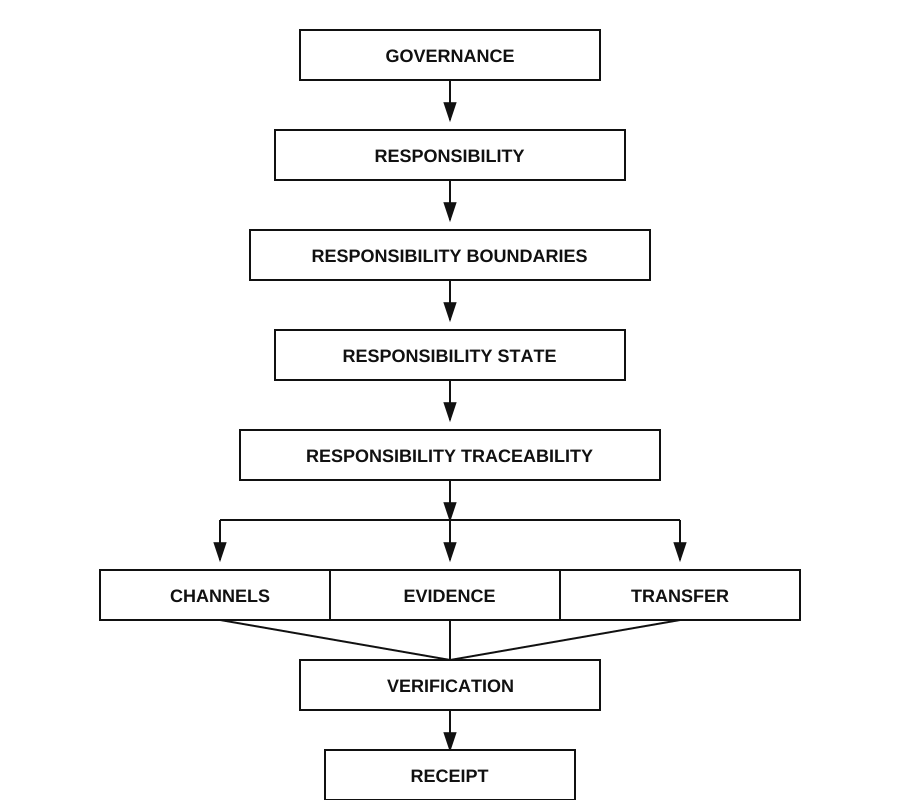
The architectural components do not operate independently. Responsibility Governance provides oversight across the architecture. Responsibility Boundaries establish the limits of the obligation. Responsibility State records its condition through time. Responsibility Traceability preserves continuity between states. Responsibility Channels support communication and preservation. Responsibility Evidence substantiates responsibility claims. Responsibility Transfer governs custody changes. Responsibility Verification evaluates evidence and related state claims. Responsibility Receipt records recognised completion or discharge.
5. Architectural Integrity
The architectural components defined within this publication are interdependent. The removal, failure, or impairment of any component may weaken the ability to establish, preserve, verify, transfer, or reconstruct responsibility.
A Responsibility Infrastructure environment is therefore evaluated not merely by the presence of individual components but by the continued integrity of the architecture as a whole.
The architecture operates as an integrated system rather than a collection of independent functions. Responsibility becomes increasingly reliable as the architectural components operate together in a coordinated manner.
6. Keywords
Responsibility Infrastructure, Provable Responsibility, Architecture, Responsibility Governance, Responsibility Boundaries, Responsibility State, Responsibility Traceability, Responsibility Channels, Responsibility Evidence, Responsibility Transfer, Responsibility Verification, Responsibility Receipt