
1. Purpose
RI-001 defines the Responsibility Infrastructure framework. RI-002 establishes the principles through which responsibility becomes provable. RI-003 defines the core architectural elements of the framework. RI-004 defines the universal structure of a Responsibility Record.
This publication defines the characteristics through which Responsibility Infrastructure may be identified, examined, distinguished, and evaluated.
The characteristics defined within this publication describe the observable qualities of a functioning Responsibility Infrastructure environment. They do not, by themselves, establish formal conformance, Recognition, Registry standing, or institutional authority.
2. Scope
The characteristics defined in this publication apply across sectors, technologies, organisational structures, jurisdictions, and operating environments.
Responsibility Infrastructure may be implemented through digital platforms, physical records, organisational procedures, integrated systems, shared protocols, artificial intelligence systems, or mixed human and machine environments.
The technology used may vary. The identifying characteristics of the framework must remain observable.
3. Definition of an Identifying Characteristic
An identifying characteristic is an observable structural quality through which an environment may be examined to determine whether it supports provable responsibility.
An identifying characteristic does not describe a particular product, interface, software implementation, or commercial service. It describes a quality that must remain present irrespective of implementation method.
4. Core Characteristics
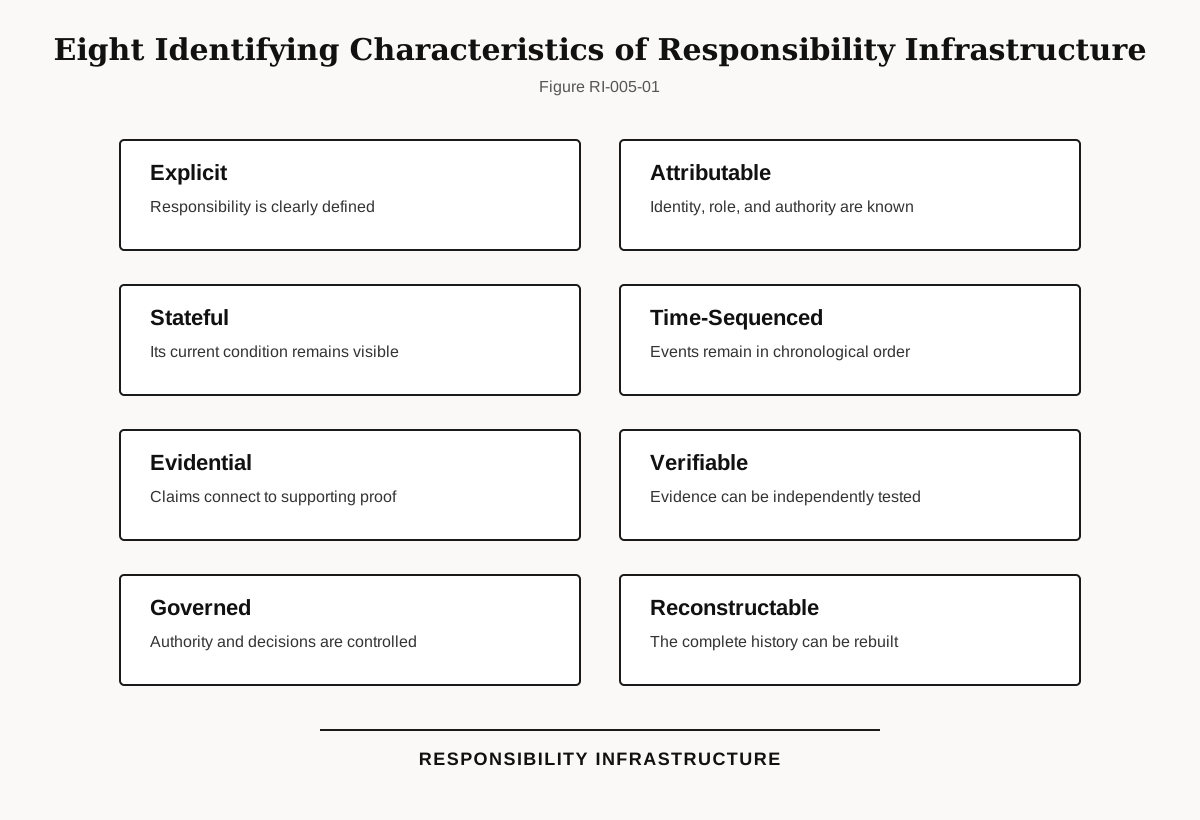
Responsibility Infrastructure is characterised by the following integrated qualities.
4.1 Responsibility Is Explicit
Responsibility exists as a defined and identifiable object.
It is not left solely as an assumption, informal expectation, general duty, vague instruction, or unrecorded understanding.
The responsibility can be referenced and examined independently of the surrounding conversation or operational environment.
4.2 Responsibility Is Attributable
Responsibility is connected to identifiable actors, roles, systems, organisations, or authorities.
The record may identify:
- who created or captured the responsibility;
- who assigned it;
- who received it;
- who acknowledged, accepted, refused, deferred, or contested it;
- who acted;
- who submitted evidence; and
- who verified the claimed outcome.
Responsibility cannot be reliably established where identity, role, or authority remains unclear.
4.3 Responsibility Is Stateful
Responsibility has a visible and recorded condition throughout its lifecycle.
The record preserves material states such as assignment, acknowledgement, acceptance, refusal, contest, action, escalation, transfer, verification, completion, discharge, or unresolved status.
Silence, delay, refusal, dispute, missing evidence, and failed action must not disappear into an undefined condition.
4.4 Responsibility Is Time-Sequenced
Responsibility Infrastructure preserves the chronological order of material events.
The record can show:
- when responsibility originated;
- when it was assigned or transferred;
- when a response was recorded;
- when action occurred;
- how long each state remained active; and
- whether required events occurred within the relevant time boundary.
This distinguishes a Responsibility Record from a collection of disconnected documents, messages, or retrospective notes.
4.5 Responsibility Is Evidential
Responsibility-related claims are connected to supporting evidence.
The relationship between the responsibility, action, evidence, and claimed outcome must remain clear.
The record should make it possible to determine:
- what the evidence relates to;
- who created or submitted it;
- when it was created or submitted;
- what claim it supports;
- what limitations apply to it; and
- whether its integrity has been preserved.
A file attachment alone does not necessarily constitute Responsibility Evidence. Evidence becomes meaningful when its connection to the responsibility lifecycle is established.
4.6 Responsibility Is Verifiable
Responsibility Infrastructure distinguishes between an assertion and an independently examined determination.
A person or system may claim that an action occurred or that a responsibility was completed. Verification determines whether the available record and evidence support that claim.
Verification may confirm, reject, qualify, suspend, or leave indeterminate a claimed outcome.
Completion is therefore not established solely through self-declaration.
4.7 Responsibility Is Governed
Authority within Responsibility Infrastructure is defined and controlled.
The environment identifies who may:
- create or assign responsibility;
- acknowledge, accept, refuse, or contest it;
- vary its scope or conditions;
- submit or evaluate evidence;
- verify a claimed outcome;
- resolve a challenge or dispute;
- recognise an outcome; and
- publish authoritative standing.
The creation, execution, verification, Recognition, and publication of an outcome are distinct functions.
These functions must not be treated as identical merely because one organisation or system participates in more than one stage.
4.8 Responsibility Is Reconstructable
Responsibility Infrastructure preserves sufficient information to reconstruct the responsibility lifecycle after the immediate event has passed.
An authorised examiner should be able to determine:
- what responsibility existed;
- how and when it originated;
- who received and held it;
- what response was made;
- what state transitions occurred;
- what action followed;
- what evidence existed;
- how verification occurred; and
- what current or final outcome remains.
Corrections, variations, challenges, transfers, reversals, and later determinations should be added to the history rather than silently replacing earlier records.
5. Relationship Between the Characteristics
The characteristics defined within this publication are interdependent.
Responsibility may be explicit but not attributable, attributable but not stateful, stateful but not evidenced, evidenced but not verifiable, or verifiable but not reconstructable.
In each case, the ability to rely upon the responsibility record becomes impaired.
Responsibility Infrastructure is therefore evaluated through the combined operation of the characteristics rather than through the isolated presence of individual features.
The presence of a task, log, approval, document, signature, dashboard, or audit trail does not by itself establish Responsibility Infrastructure.
6. Responsibility Infrastructure Identification Test
An environment claiming to operate as Responsibility Infrastructure should be capable of answering the following questions from its own records:
- What responsibility existed?
- How and when did the responsibility originate?
- Who assigned, received, and held it?
- What response was recorded?
- What state existed at each material point?
- What action occurred?
- What evidence supports the claimed action or outcome?
- Who verified the claim, and on what basis?
- What challenge, variation, transfer, or escalation occurred?
- What complete and retrievable record remains?
Where these questions cannot be answered from the environment itself, the environment may support responsibility-related work but does not yet demonstrate complete Responsibility Infrastructure.
7. Framework Boundary
The following mechanisms may support Responsibility Infrastructure but do not constitute Responsibility Infrastructure by themselves:
- task lists;
- project-management boards;
- messaging systems;
- email trails;
- document repositories;
- dashboards;
- audit logs;
- case-management systems;
- digital signatures;
- compliance checklists;
- automated alerts;
- self-declared completion records; and
- retrospective incident reports.
These mechanisms may preserve fragments of activity.
Responsibility Infrastructure connects responsibility, identity, state, action, evidence, verification, governance, history, and outcome into a coherent and reconstructable Responsibility Record.
Responsibility Infrastructure functions as a system of record. It should not be confused with Accountability Infrastructure, which functions as a system of judgment.
8. Relationship to Other Publications
This publication should be read alongside the following instruments:
- RI-001 — Definition of the Responsibility Infrastructure Framework.
- RI-002 — Principles of Provable Responsibility.
- RI-003 — Core Elements of Responsibility Infrastructure.
- RI-004 — The Responsibility Record Specification.
- RI-STD-01 — The Responsibility Chain.
- RI-STD-02 — Responsibility Evidence Requirements.
- RI-STD-03 — Responsibility Verification Requirements.
RI-005 provides the identifying characteristics through which the foundations defined by RI-001 to RI-004 may be observed and examined within an operational environment.
9. Foundational Statement
Responsibility Infrastructure is identifiable where responsibility is explicit, attributable, stateful, time-sequenced, evidential, verifiable, governed, and reconstructable.
A system may contain responsibility-related features without satisfying these characteristics as an integrated whole.
Structural similarity does not establish conformance, Recognition, Registry standing, or equivalence.
10. Keywords
Responsibility Infrastructure, Characteristics, Identifiability, Attribution, Responsibility State, Time Sequence, Responsibility Evidence, Responsibility Verification, Responsibility Governance, Responsibility Record, Reconstructability, Framework Boundary