
1. Purpose
This publication defines the distinction between Responsibility Infrastructure and Accountability Infrastructure.
The two categories may interact closely, but they perform different institutional functions. Confusing them may weaken evidence integrity, decision independence, procedural fairness, and the ability to reconstruct what occurred.
2. Scope
This publication applies wherever responsibility records may later be relied upon for review, investigation, regulation, dispute resolution, assurance, legal proceedings, disciplinary action, or another form of institutional judgment.
It defines the functional boundary between recording responsibility truth and judging conduct, fault, consequence, or remedy.
3. Core Distinction
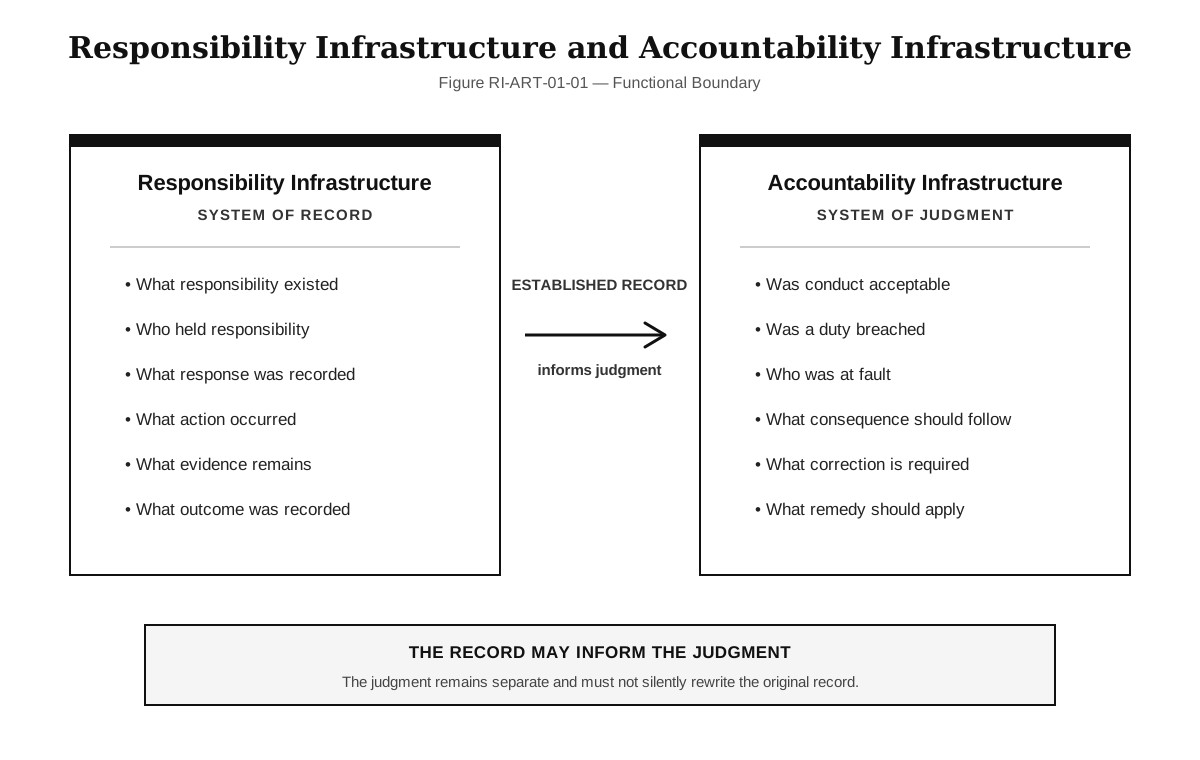
Responsibility Infrastructure functions as a system of record.
Accountability Infrastructure functions as a system of judgment.
Responsibility Infrastructure preserves what responsibility existed, who held it, what response was recorded, what action occurred, what evidence remains, how claims were verified, and what outcome was recognised.
Accountability Infrastructure determines what those facts mean for conduct, compliance, fault, liability, consequence, sanction, correction, or remedy.
4. Responsibility Infrastructure
Responsibility Infrastructure establishes and preserves the responsibility record.
Its functions may include:
- capturing responsibility as an identifiable object;
- recording assignment and acknowledgement;
- preserving response states;
- recording actions and state transitions;
- connecting claims to evidence;
- supporting verification;
- preserving transfers, challenges, corrections, and variations;
- recording recognised outcomes;
- publishing authoritative standing; and
- supporting reconstruction of the complete responsibility lifecycle.
Responsibility Infrastructure does not automatically determine guilt, blame, liability, punishment, compensation, or remedy.
5. Accountability Infrastructure
Accountability Infrastructure evaluates conduct and determines what should follow from established facts, rules, duties, standards, or legal requirements.
Its functions may include:
- assessing compliance or non-compliance;
- determining fault or responsibility for failure;
- evaluating professional or organisational conduct;
- deciding whether sanctions or corrective measures are required;
- determining liability or remedy;
- authorising disciplinary or regulatory action;
- resolving disputes; and
- requiring restitution, correction, compensation, or another consequence.
Accountability Infrastructure may rely upon Responsibility Infrastructure, but it performs a separate function.
6. Verification Is Not Accountability Judgment
Verification examines whether a responsibility-related claim is supported by the available record and evidence.
A verifier may determine that evidence confirms, rejects, qualifies, suspends, or leaves indeterminate a claim.
That determination does not automatically decide whether a person or organisation should be blamed, sanctioned, compensated, disciplined, or otherwise held accountable.
Verification answers: Does the evidence support the claim?
Accountability judgment answers: What should follow from the established facts?
7. Recognition Is Not Fault Judgment
Recognition is a formal determination that a defined claim, record, outcome, or implementation satisfies specified criteria.
Recognition does not necessarily determine fault, guilt, liability, misconduct, or remedy.
A recognised Responsibility Record may later be relied upon by a regulator, court, employer, professional body, insurer, investigator, or other authorised decision-maker.
The later accountability decision remains separate from the responsibility record and its Recognition.
8. Relationship Between the Categories
Responsibility Infrastructure and Accountability Infrastructure may operate sequentially.
A typical relationship is:
- Responsibility Infrastructure preserves the responsibility lifecycle.
- Evidence is connected to responsibility-related claims.
- Verification examines whether the claims are supported.
- Recognition may establish that specified criteria were satisfied.
- The Registry may publish authoritative standing.
- An accountability authority may later rely upon that record when making a judgment.
Responsibility Infrastructure strengthens Accountability Infrastructure by providing a more complete, attributable, time-sequenced, evidential, verifiable, and reconstructable record.
Accountability Infrastructure should not silently alter the underlying Responsibility Record merely because it reaches a later judgment.
9. Why the Boundary Matters
The boundary protects the integrity of both categories.
Where the system responsible for recording events also controls the final judgment, there may be a risk that evidence, state, interpretation, and consequence become improperly combined.
Maintaining separation helps preserve:
- record integrity;
- independent examination;
- procedural fairness;
- clear authority;
- challenge and appeal rights;
- reconstruction of the original record; and
- confidence in later decisions.
10. Framework Identification Test
A function primarily belongs to Responsibility Infrastructure where it answers questions such as:
- What responsibility existed?
- Who held it?
- What response was recorded?
- What action occurred?
- What evidence supports the claim?
- What verification occurred?
- What record remains?
A function primarily belongs to Accountability Infrastructure where it answers questions such as:
- Was the conduct acceptable?
- Was a duty breached?
- Who was at fault?
- What consequence should follow?
- What correction or remedy is required?
11. Framework Boundary
Responsibility Infrastructure may support accountability without becoming Accountability Infrastructure.
Accountability Infrastructure may rely upon responsibility records without controlling how those records were originally created, preserved, verified, recognised, or published.
The categories should therefore remain interoperable but constitutionally distinct.
12. Relationship to Other Publications
This publication should be read alongside:
- RI-001 — Definition of the Responsibility Infrastructure Framework.
- RI-002 — Principles of Provable Responsibility.
- RI-003 — Core Elements of Responsibility Infrastructure.
- RI-004 — The Responsibility Record Specification.
- RI-005 — Characteristics of Responsibility Infrastructure.
- RI-GLOSS-01 — Responsibility Infrastructure Glossary.
- RI-FAQ-01 — Responsibility Infrastructure Frequently Asked Questions.
- RI-STD-03 — Responsibility Verification Requirements.
13. Foundational Statement
Responsibility Infrastructure records responsibility truth. Accountability Infrastructure judges what should follow from that truth.
The record and the judgment may interact, but they must not be treated as the same institutional function.
14. Keywords
Responsibility Infrastructure, Accountability Infrastructure, System of Record, System of Judgment, Responsibility Record, Evidence, Verification, Recognition, Registry, Accountability, Fault, Liability, Consequence, Remedy, Institutional Separation