
1. Purpose
This standard defines the minimum requirements for verification within a Responsibility Infrastructure environment.
Its purpose is to ensure that responsibility-related claims are examined through an attributable, evidence-based, appropriately independent, and reconstructable process.
Verification determines whether the available Responsibility Record and evidence support a defined claim. It does not automatically create Recognition, Registry standing, accountability judgment, liability, sanction, or remedy.
2. Scope
This standard applies where a responsibility-related claim, state, action, transfer, completion, discharge, closure, or outcome requires verification.
It applies across human, organisational, technical, administrative, legal, physical, digital, and artificial intelligence environments.
Verification may be performed by a person, team, organisation, authorised function, technical system, or combined human and machine process where the applicable authority, role, criteria, evidence, limitations, and determination remain identifiable.
3. Normative Language
The terms shall, should, and may are used as follows:
- shall identifies a mandatory requirement;
- should identifies a recommended practice; and
- may identifies a permitted option.
4. Definition of Verification
Verification is the attributable and appropriately separated examination of a responsibility-related claim against defined criteria using the available Responsibility Record and evidence.
Verification answers: Does the available record and evidence support the claim being examined?
Verification shall remain distinguishable from:
- the original responsibility;
- the action or event being examined;
- the submission of evidence;
- self-declared completion;
- Recognition;
- Registry publication;
- certification or accreditation;
- accountability judgment;
- fault or liability determination; and
- sanction, consequence, or remedy.
5. Verification Principles
A valid verification process shall preserve:
- a defined claim;
- a defined scope;
- identifiable criteria;
- attributable authority;
- appropriate independence or separation;
- an identifiable evidence set;
- documented examination;
- reasoned determination;
- visible limitations and uncertainty;
- challenge and correction capability; and
- a reconstructable verification record.
6. Verification Claim
6.1 Defined Claim
Verification shall examine a defined claim.
The claim shall identify what is being asserted, by whom, in relation to which responsibility, action, state, event, transfer, or outcome.
6.2 Claim Precision
A claim shall be sufficiently precise to permit examination against identifiable evidence and criteria.
Broad statements such as “completed,” “approved,” “compliant,” “safe,” or “resolved” shall not be treated as adequately defined where their scope, conditions, or required outcome remain unclear.
6.3 Multiple Claims
Where a submission contains multiple claims, each material claim should be identified separately.
Verification of one claim shall not automatically verify every related or accompanying claim.
7. Verification Scope
7.1 Scope Definition
The verification scope shall identify:
- the Responsibility Record being examined;
- the claim or claims under examination;
- the relevant lifecycle stage or period;
- the actors, systems, organisations, or authorities included;
- the applicable criteria;
- the evidence considered within scope;
- any exclusions;
- any material dependency; and
- the intended level of reliance.
7.2 Scope Limitation
A verification determination shall not be presented as applying beyond its recorded scope.
Evidence or activity outside scope may be preserved without being treated as examined.
7.3 Scope Change
A material change in scope shall be recorded.
Where the change could affect the verification method, authority, evidence set, criteria, or determination, the verification process should be reassessed.
8. Verification Authority
8.1 Defined Authority
The verifier shall possess defined authority to perform the verification.
The verification record shall identify:
- the verifier;
- the verifier's role;
- the source of authority;
- the scope of that authority;
- any limitation or condition; and
- the date or period during which the authority applied.
8.2 Competence
The verifier shall possess or have access to the competence reasonably required to examine the claim, evidence, criteria, and relevant context.
Competence may include technical knowledge, professional experience, legal understanding, sector expertise, evidential analysis, operational knowledge, or another capability relevant to the verification.
8.3 Authority Is Not Recognition
Authority to verify does not automatically create authority to grant Recognition, publish Registry standing, issue sanctions, determine liability, or decide remedy.
9. Independence and Separation
9.1 Independence Requirement
Verification shall be performed with sufficient independence or functional separation to support reliable examination of the claim.
The degree of independence required shall be proportionate to the risk, significance, intended reliance, and potential consequence of error.
9.2 Self-Verification
The person, system, team, or organisation making the original claim shall not treat its own declaration as independent verification.
An internal verifier may perform verification where sufficient functional separation, authority, competence, and freedom to reject the claim can be demonstrated.
9.3 Freedom to Reject
A verifier shall have genuine freedom to reject, qualify, suspend, or leave indeterminate the claim.
A process does not demonstrate meaningful verification where the verifier is required, pressured, technically constrained, financially dependent, or procedurally unable to reach an adverse determination.
9.4 Independence Record
The verification record should identify the relationship between:
- the claimant;
- the responsible actor;
- the evidence submitter;
- the verifier;
- the Recognition authority, where applicable; and
- the Registry publisher, where applicable.
10. Conflicts of Interest
10.1 Disclosure
A verifier shall disclose any material interest that may reasonably call their impartiality into question.
A conflict may arise from:
- financial interest;
- ownership or licensing interest;
- employment or contractual dependence;
- participation in the action being verified;
- authorship or control of the evidence;
- personal or organisational relationships;
- performance targets linked to the outcome;
- prior public commitment to a result; or
- another interest capable of affecting independent judgment.
10.2 Management of Conflict
A material conflict shall be removed, mitigated, disclosed, or otherwise managed before the verification determination is relied upon.
10.3 Recusal
Where a conflict cannot be adequately managed, the verifier shall recuse themselves.
The recusal and replacement authority should be recorded.
11. Verification Criteria
11.1 Defined Criteria
Verification shall apply identifiable criteria.
Criteria may arise from:
- a Responsibility Infrastructure publication or standard;
- a contract or agreed requirement;
- a law or regulation;
- a policy or procedure;
- a technical specification;
- a professional requirement;
- a Recognition framework;
- a defined responsibility outcome; or
- another attributable source.
11.2 Criteria Version
Where criteria are versioned, the applicable version and effective date shall be recorded.
11.3 No Hidden Criteria
A claim shall not be rejected or qualified on the basis of material criteria that were unavailable, undisclosed, or introduced after the relevant activity without the effect of that change being recorded.
11.4 Interpretation
Where criteria require interpretation, the interpretation, source, reasoning, and effect upon the determination should be recorded.
12. Verification Evidence Set
12.1 Defined Evidence Set
The verification record shall identify the evidence relied upon.
The evidence set should distinguish:
- evidence examined;
- evidence excluded;
- evidence unavailable;
- evidence challenged;
- evidence considered insufficient;
- evidence added during verification; and
- evidence created after the underlying event.
12.2 Evidence Requirements
Evidence relied upon during verification shall be examined in accordance with the applicable Responsibility Evidence requirements.
The existence of an attachment, log, signature, statement, model output, recording, or document shall not automatically establish reliability or sufficiency.
12.3 Missing Evidence
Where required or expected evidence is missing, the absence and its effect upon the claim shall be recorded.
12.4 Conflicting Evidence
Conflicting evidence shall not be silently removed.
The verifier should record the conflict, the basis for any weighting or preference, and any uncertainty that remains.
13. Lifecycle Completeness
13.1 Responsibility Chain Examination
Verification shall consider whether the relevant Responsibility Chain is sufficiently complete for the claim being examined.
The verifier should be able to determine, where applicable:
- what responsibility was captured;
- who assigned it;
- who received or acknowledged it;
- what Response State was recorded;
- what action occurred;
- what evidence supports the claim;
- what transfers, escalations, variations, or challenges occurred; and
- what outcome is being claimed.
13.2 Incomplete Chain
An incomplete Responsibility Chain does not automatically require rejection.
The missing stage or connection and its effect upon the determination shall remain visible.
13.3 No Retrospective Reconstruction Without Disclosure
A reconstructed or retrospectively completed record shall not be presented as contemporaneous where it was created after the relevant event.
14. Verification Method
14.1 Documented Method
The verification method shall be appropriate to the claim, criteria, evidence, risk, and intended reliance.
The record should identify the material examination methods used.
14.2 Permitted Methods
Verification methods may include:
- document review;
- record comparison;
- data analysis;
- interview or testimony review;
- physical inspection;
- technical testing;
- system or log examination;
- sampling;
- reperformance;
- cross-source corroboration;
- expert assessment;
- automated analysis;
- human review of machine-generated outputs; or
- another recorded method.
14.3 Sampling
Where sampling is used, the record should identify the population, sample method, sample size, selection basis, limitations, and effect upon the determination.
14.4 Verification Depth
The depth of verification shall be proportionate to the importance of the claim and the consequence of incorrect reliance.
15. Verification Process
A verification process should include:
- receipt of the verification request;
- identification of the claim;
- confirmation of scope;
- confirmation of verifier authority and independence;
- identification of applicable criteria;
- identification and preservation of the evidence set;
- examination of the Responsibility Record;
- assessment of evidence relevance, integrity, and sufficiency;
- identification of gaps, conflicts, and limitations;
- formation of a reasoned determination;
- recording of the verification outcome;
- review or approval where required; and
- preservation of the Verification Record.
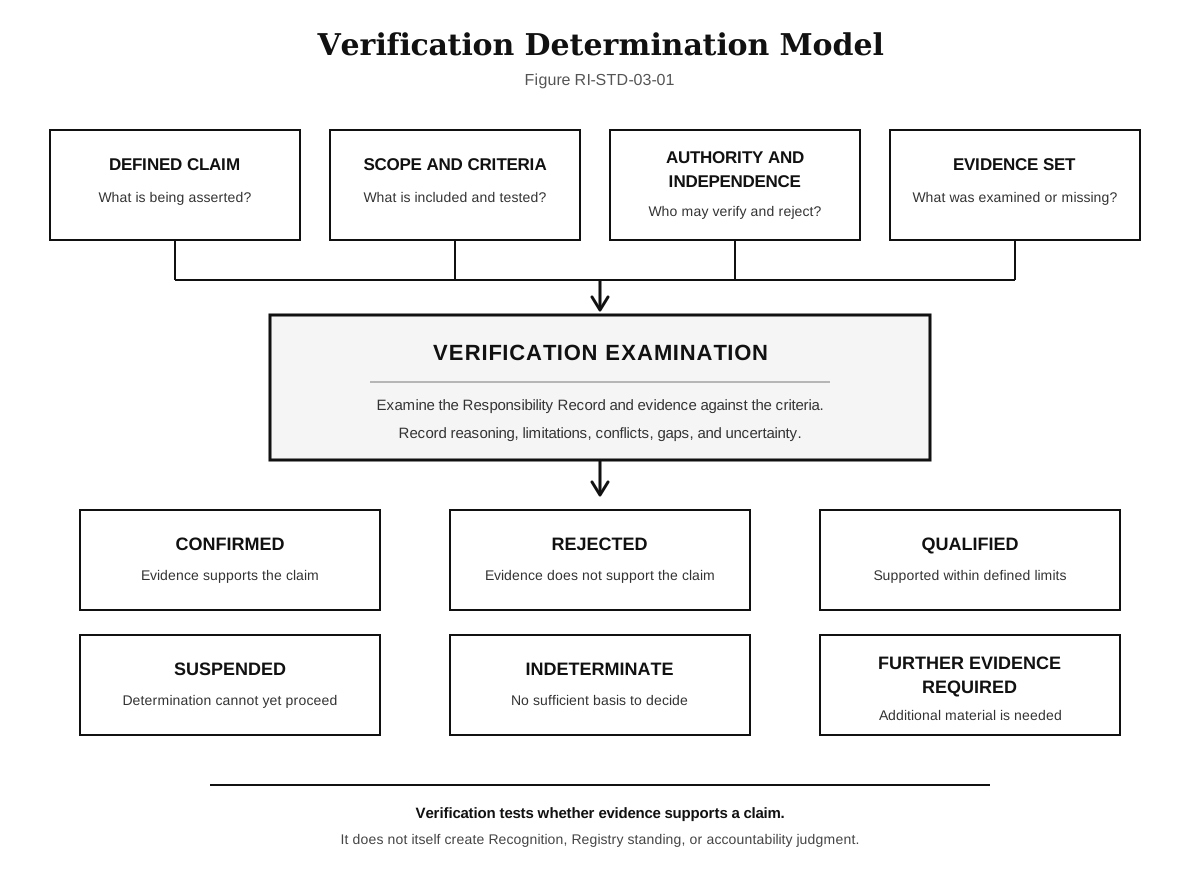
16. Verification Determinations
16.1 Confirmed
A claim may be confirmed where the available record and evidence support the claim against the applicable criteria.
16.2 Rejected
A claim may be rejected where the available record or evidence contradicts the claim or fails to satisfy the applicable criteria.
16.3 Qualified
A claim may be qualified where it is supported only within defined limits, conditions, exclusions, or uncertainties.
16.4 Suspended
A determination may be suspended where verification cannot reasonably be completed until additional evidence, authority, clarification, access, or action becomes available.
16.5 Indeterminate
A claim may remain indeterminate where the available record does not provide a sufficient basis to confirm or reject it.
16.6 Further Evidence Required
The verifier may request further evidence without implying that the claim is confirmed or rejected.
17. Verification Reasoning
A verification determination shall be supported by recorded reasons.
The reasoning should identify:
- the claim examined;
- the applicable criteria;
- the material evidence relied upon;
- evidence excluded or unavailable;
- material conflicts or gaps;
- the examination performed;
- the reasoning connecting evidence to the determination;
- any limitation or uncertainty; and
- the final verification outcome.
A conclusory statement such as “verified,” “passed,” “approved,” or “complete” shall not be treated as an adequate Verification Record where the basis cannot be reconstructed.
18. Verification Record
Every material verification shall produce a Verification Record.
The Verification Record shall include:
- a verification identifier;
- the related Responsibility Record;
- the claim or claims examined;
- the verification scope;
- the verifier's identity, role, authority, and independence position;
- the applicable criteria;
- the evidence set;
- the examination method;
- the verification reasoning;
- the determination;
- limitations, qualifications, exclusions, and uncertainty;
- the date and time of determination;
- any review or approval;
- challenge or appeal information, where applicable; and
- the current status of the Verification Record.
19. Verification Report
A Verification Report is the structured output through which a Verification Record may be communicated and relied upon.
A Verification Report shall not omit material limitations, unresolved evidence gaps, conflicts, qualifications, or exclusions merely to produce a simpler conclusion.
The report should enable an authorised reader to understand:
- what was examined;
- what was not examined;
- what evidence was relied upon;
- what criteria were applied;
- who performed the verification;
- what determination was reached; and
- why that determination was reached.
20. Human Verification
Where verification is performed by a human, the record should identify:
- the verifier's identity;
- role and authority;
- relevant competence;
- independence or separation;
- conflicts of interest;
- material judgments made;
- evidence examined;
- criteria applied; and
- the basis of the determination.
21. Automated and Artificial Intelligence Verification
21.1 Permitted Use
Automated systems and artificial intelligence may support verification where their role, authority, inputs, outputs, limitations, and human oversight remain identifiable.
21.2 Required Record
Where automation materially affects a verification determination, the record should identify:
- the system or model used;
- the function performed;
- the input evidence;
- the output produced;
- the criteria or rules applied;
- the date and time of processing;
- known limitations or uncertainty;
- material human intervention;
- the responsible human or organisational authority; and
- whether the automated output could be challenged or overridden.
21.3 No Automatic Independence
An automated output shall not be treated as independent merely because it was generated by software or artificial intelligence.
Independence depends upon authority, control, incentives, evidence access, configuration, and freedom to reach an adverse determination.
21.4 Human Rubber-Stamping
Human involvement shall not be treated as meaningful verification where the human lacks authority, competence, information, time, discretion, or practical ability to change the outcome.
22. Verification Review
A verification process may include technical, supervisory, procedural, or quality review.
Where review is required, the record should identify:
- the reviewer;
- the review authority;
- the matters reviewed;
- the date and time;
- any changes required;
- any disagreement; and
- the final approved determination.
Review shall not silently replace the original verifier's recorded reasoning where preservation is necessary for reconstruction.
23. Challenge and Appeal
23.1 Verification Challenge
A verification determination may be challenged on grounds including:
- incorrect scope;
- insufficient authority;
- lack of independence;
- conflict of interest;
- incorrect criteria;
- missing or excluded evidence;
- evidence integrity concerns;
- procedural failure;
- unsupported reasoning;
- material factual error;
- new evidence; or
- another matter affecting reliance.
23.2 Challenge Record
The challenge shall be added to the Responsibility Record and shall not erase the original Verification Record.
23.3 Appeal
Where an appeal process exists, the authority, scope, procedure, evidence rules, decision, and relationship to the earlier verification shall be recorded.
24. Correction, Amendment, and Reverification
24.1 Correction
A Verification Record may be corrected where an error is identified.
The correction shall preserve:
- the original record;
- the corrected information;
- the reason for correction;
- the correcting authority;
- the date and time; and
- the effect upon the determination.
24.2 Reverification
Reverification may be required where:
- material new evidence becomes available;
- the original evidence is shown to be unreliable;
- the criteria change;
- the scope changes;
- a conflict of interest is discovered;
- a procedural failure affected the result;
- the responsibility outcome changes; or
- another event materially affects reliance.
24.3 No Silent Replacement
A later verification shall not silently erase or replace the earlier Verification Record.
The relationship between the determinations shall remain reconstructable.
25. Verification Status
A Verification Record may hold a status such as:
- requested;
- accepted for verification;
- in progress;
- awaiting evidence;
- suspended;
- confirmed;
- rejected;
- qualified;
- indeterminate;
- challenged;
- under appeal;
- superseded;
- withdrawn; or
- another explicitly defined status.
The current status shall not conceal earlier states.
26. Verification and Receipt
A Responsibility Receipt may rely upon a completed Verification Record.
The Receipt should identify the verification determination and provide a means of retrieving or referencing the underlying Responsibility Record.
A Receipt shall not expand the scope of the verification determination or conceal its qualifications and limitations.
27. Verification, Recognition, and Registry Publication
Verification determines whether evidence supports a claim.
Recognition determines whether a claim, record, outcome, or implementation satisfies defined Recognition criteria through an authorised process.
Registry publication records authoritative standing after the applicable determination and publication requirements have been satisfied.
Verification does not automatically create Recognition. Recognition does not automatically permit silent alteration of the Verification Record. Registry publication does not replace the underlying evidence, reasoning, or determination.
28. Verification and Accountability Judgment
Verification is not an accountability judgment.
A verification determination may later be relied upon by a court, regulator, employer, professional body, insurer, investigator, or other authorised decision-maker.
That later authority determines what consequence, liability, sanction, correction, or remedy should follow.
29. Conformance Requirements
An implementation conforms with this standard only where it can demonstrate that material verification:
- examines a defined claim;
- operates within a recorded scope;
- uses identifiable criteria;
- is performed by an attributable and authorised verifier;
- demonstrates appropriate independence or separation;
- records and manages material conflicts of interest;
- identifies the evidence examined, excluded, missing, or challenged;
- examines relevant Responsibility Chain completeness;
- uses a documented and proportionate method;
- records material gaps, conflicts, limitations, and uncertainty;
- produces a reasoned determination;
- preserves a complete Verification Record;
- supports challenge, correction, and reverification; and
- allows the verification history to be reconstructed.
A checkbox, approval field, signature, automated score, dashboard status, self-declaration, or unreasoned “verified” label does not by itself establish conformance.
30. Relationship to Other Publications
This standard should be read alongside:
- RI-001 — Definition of the Responsibility Infrastructure Framework.
- RI-002 — Principles of Provable Responsibility.
- RI-003 — Core Elements of Responsibility Infrastructure.
- RI-004 — The Responsibility Record Specification.
- RI-005 — Characteristics of Responsibility Infrastructure.
- RI-GLOSS-01 — Responsibility Infrastructure Glossary.
- RI-STD-01 — The Responsibility Chain.
- RI-STD-02 — Responsibility Evidence Requirements.
- RI-REG-01 — Responsibility Infrastructure Registry Framework.
31. Normative Statement
A responsibility-related claim shall not be treated as verified solely because it was asserted, recorded, approved, signed, submitted, scored, or declared complete.
Verification requires attributable authority, appropriate independence, identifiable criteria, evidence examination, reasoned determination, and a reconstructable Verification Record.
32. Keywords
Responsibility Infrastructure, Responsibility Verification, Verification Requirements, Verification Record, Verification Report, Verification Claim, Verification Scope, Verification Criteria, Verifier Independence, Evidence Review, Lifecycle Completeness, Verification Determination, Qualified Verification, Indeterminate Outcome, Conflict of Interest, Reverification, Recognition, Registry