
1. Purpose
This standard defines the minimum requirements for Responsibility Evidence within a Responsibility Infrastructure environment.
Its purpose is to ensure that responsibility-related claims remain connected to evidence that is identifiable, attributable, relevant, time-sequenced, preserved, accessible, and capable of verification.
The presence of a document, attachment, message, record, image, signature, data point, or system log does not by itself establish valid Responsibility Evidence.
2. Scope
This standard applies to evidence created, captured, submitted, generated, received, preserved, amended, challenged, transferred, or examined throughout a Responsibility Chain.
It applies across physical, digital, administrative, legal, organisational, technical, human, and machine-generated environments.
This standard governs the structural requirements of Responsibility Evidence. It does not determine whether a person or organisation is at fault, liable, guilty, compliant, or deserving of sanction or remedy.
3. Normative Language
The terms shall, should, and may are used as follows:
- shall identifies a mandatory requirement;
- should identifies a recommended practice; and
- may identifies a permitted option.
4. Definition of Responsibility Evidence
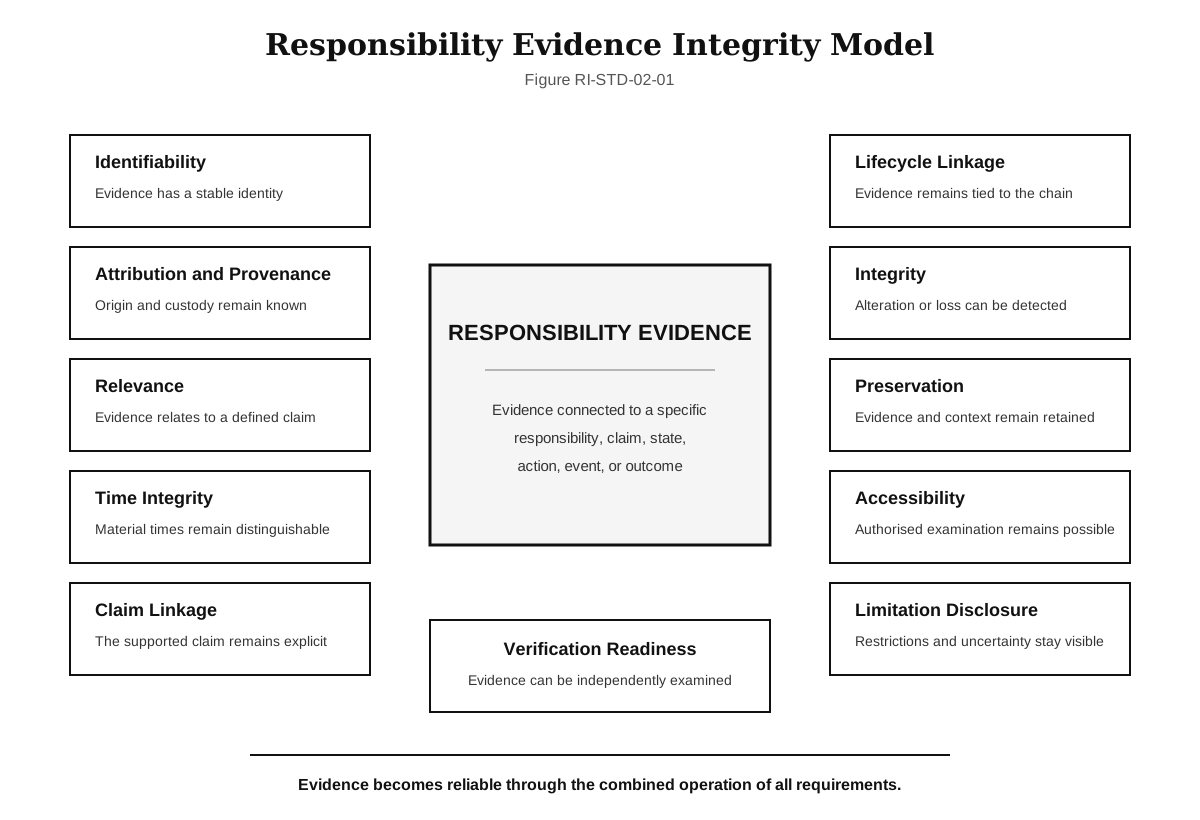
Responsibility Evidence is information, data, material, observation, record, artefact, communication, or other content connected to a specific responsibility-related claim, event, state, action, transfer, verification, or outcome.
Evidence becomes Responsibility Evidence only where its relationship to the relevant responsibility lifecycle can be established.
Responsibility Evidence shall remain distinguishable from:
- the responsibility itself;
- the claim being made;
- the action being described;
- the verification determination;
- the Recognition decision;
- the Registry publication; and
- any later accountability judgment.
5. Core Evidence Requirements
Responsibility Evidence shall satisfy the following requirements:
- identifiability;
- attribution and provenance;
- relevance;
- time integrity;
- claim linkage;
- lifecycle linkage;
- integrity;
- preservation;
- accessibility;
- limitation disclosure; and
- verification readiness.
Failure to satisfy one or more requirements shall be recorded where it materially affects reliance upon the evidence.
6. Evidence Identification
6.1 Evidence Identity
Each material evidence item shall be capable of identification.
The evidence record should include:
- a unique identifier or stable reference;
- a description of the evidence;
- the evidence type;
- the relevant Responsibility Record;
- the claim, action, state, event, transfer, or outcome to which it relates;
- the date and time of creation, where known;
- the date and time of submission or capture;
- the submitting actor or system; and
- the current evidence status.
6.2 Stable Reference
An evidence reference shall remain sufficiently stable to allow later retrieval, examination, challenge, correction, and reconstruction.
Changing a filename, location, storage system, or technical format shall not silently break the connection between the evidence and the Responsibility Record.
7. Attribution and Provenance
7.1 Attribution
Responsibility Evidence shall identify, where known:
- who or what created it;
- who submitted or captured it;
- who controlled the source environment;
- who amended or transformed it;
- who transferred or received it; and
- who had material custody of it.
7.2 Provenance
Provenance is the recorded origin and history of an evidence item.
The provenance record should preserve:
- the original source;
- the method of creation or collection;
- the original format, where relevant;
- material custody changes;
- transformations or conversions;
- amendments or annotations;
- known access events affecting integrity; and
- the relationship between the original and any derived copy.
7.3 Unknown Origin
Evidence of unknown or uncertain origin may be preserved.
The uncertainty shall be recorded and shall not be concealed through later attribution.
8. Evidence Relevance
8.1 Connection to a Claim
Evidence shall be connected to a defined responsibility-related claim, event, state, action, transfer, or outcome.
The record shall make clear what the evidence is being relied upon to establish.
8.2 Direct and Indirect Evidence
Evidence may be direct or indirect.
Where evidence is indirect, inferential, contextual, statistical, or dependent upon another record, that relationship should be disclosed.
8.3 Irrelevant Material
Material shall not be treated as supporting evidence merely because it appears within the same file, case, communication, system, organisation, or time period.
Relevance shall be established through an explicit connection to the responsibility claim or lifecycle event.
9. Time Integrity
9.1 Material Times
The evidence record shall distinguish, where applicable:
- when the underlying event occurred;
- when the evidence was created;
- when the evidence was captured;
- when the evidence was submitted;
- when the evidence was received;
- when the evidence was amended;
- when the evidence was examined; and
- when the evidence was verified.
9.2 Retrospective Evidence
Evidence created after the event it describes may be preserved.
The record shall identify that it was created retrospectively and shall not present it as contemporaneous evidence.
9.3 Time Uncertainty
Where an exact time cannot be established, the record should preserve the known time range, source of uncertainty, or applicable estimate.
10. Lifecycle Linkage
Responsibility Evidence shall remain linked to the relevant point within the Responsibility Chain.
Evidence may relate to:
- Capture;
- Assignment;
- Acknowledgement;
- Response State;
- Action;
- Evidence submission;
- Verification;
- Receipt;
- transfer;
- escalation;
- correction;
- challenge; or
- another material lifecycle event.
An evidence item may support more than one event or claim. Each material relationship should remain identifiable.
11. Evidence Integrity
11.1 Integrity Requirement
Evidence integrity is the condition in which the evidence remains sufficiently complete, accurate, protected, and traceable for its intended use.
The evidence environment shall provide a reasonable means of identifying material alteration, corruption, substitution, deletion, or loss.
11.2 Original and Derived Evidence
Where an original evidence item is transformed, compressed, converted, transcribed, summarised, translated, redacted, extracted, or analysed, the derived item shall remain linked to its source.
The transformation shall not be presented as the unaltered original.
11.3 Integrity Controls
Integrity controls may include:
- access controls;
- version history;
- checksums or cryptographic hashes;
- digital signatures;
- tamper-evident storage;
- audit records;
- custody records;
- controlled amendment procedures; and
- independent preservation.
No particular technical control is mandatory unless required by another applicable instrument.
The controls used shall be proportionate to the evidence risk and the level of reliance expected.
12. Evidence Preservation
12.1 Preservation Requirement
Responsibility Evidence shall be preserved for as long as it remains necessary to support verification, reconstruction, challenge, review, Recognition, Registry standing, legal obligation, or another defined reliance purpose.
12.2 Preservation Context
Preservation shall maintain, where applicable:
- the evidence content;
- its identifier;
- its provenance;
- its timestamps;
- its relationship to relevant claims;
- its relationship to the Responsibility Record;
- its integrity information;
- its access restrictions;
- its limitations; and
- its lifecycle status.
12.3 Deletion and Disposal
Evidence shall not be silently deleted where its removal would prevent reconstruction or conceal an earlier responsibility state, claim, action, verification, challenge, or outcome.
Where lawful disposal occurs, the disposal event, authority, reason, date, scope, and effect should be recorded.
13. Evidence Accessibility
13.1 Retrieval
Evidence shall remain retrievable by an appropriately authorised examiner within a reasonable period.
Evidence that technically exists but cannot be located, accessed, interpreted, or connected to the relevant record may not satisfy this standard.
13.2 Format Accessibility
Evidence should be preserved in a format that remains capable of examination for the applicable retention period.
Where specialist software, hardware, keys, credentials, models, or technical knowledge are required, those dependencies should be recorded.
13.3 Restricted Evidence
Evidence may be confidential, private, privileged, commercially sensitive, security-sensitive, legally restricted, or otherwise protected.
Restriction of access does not invalidate the evidence.
The existence, authority, reason, and scope of the restriction should remain identifiable where lawful and appropriate.
14. Evidence Sufficiency
14.1 Sufficiency Is Contextual
Evidence sufficiency depends upon the claim being examined, the applicable criteria, the risk of error, the expected level of reliance, and any relevant legal, regulatory, technical, or institutional requirement.
The quantity of evidence does not by itself establish sufficiency.
14.2 Evidence Gaps
Where the available evidence is incomplete, missing, contradictory, uncertain, inaccessible, or insufficient, that condition shall be recorded.
The claim shall not be presented as conclusively supported where material evidence gaps remain unresolved.
14.3 Cumulative Evidence
Multiple evidence items may operate together to support a claim.
The record should preserve the relationship between the individual items and the combined claim.
15. Conflicting Evidence
Conflicting evidence shall not be silently removed merely because one item is preferred.
The record should identify:
- the evidence items in conflict;
- the nature of the conflict;
- the actors or systems involved;
- the effect upon the claim;
- any examination undertaken;
- the basis for any preference or weighting; and
- any unresolved uncertainty.
A later determination may explain or resolve a conflict without erasing the earlier evidence history.
16. Missing Evidence
Missing evidence shall be treated as an explicit condition where the evidence was required, expected, referenced, relied upon, requested, or known to have existed.
The record should identify:
- what evidence is missing;
- why it was expected;
- when the absence was identified;
- who identified the absence;
- any attempt made to retrieve it;
- the reason for loss or unavailability, where known; and
- the effect upon verification or the claimed outcome.
17. Evidence Amendments and Corrections
17.1 Amendment
An evidence item may be corrected, supplemented, annotated, redacted, translated, reformatted, or otherwise amended where lawful and appropriate.
The amendment shall remain attributable and time-sequenced.
17.2 No Silent Replacement
The earlier evidence state shall not be silently replaced where preservation is necessary to determine what information existed, was relied upon, or was available at an earlier time.
17.3 Correction Record
A correction should identify:
- the evidence affected;
- the original state;
- the corrected state;
- the reason for correction;
- the correcting actor or authority;
- the date and time; and
- the effect upon any claim, verification, Recognition, Registry entry, or Receipt.
18. Human-Generated Evidence
Human-generated evidence may include statements, observations, decisions, approvals, notes, reports, testimony, communications, records, or physical artefacts.
The evidence record should identify, where applicable:
- the author or observer;
- their role and authority;
- whether the evidence was contemporaneous or retrospective;
- the conditions under which it was created;
- known limitations or conflicts;
- whether the content is opinion, observation, interpretation, or fact; and
- any material assistance used in its creation.
19. Machine-Generated Evidence
Machine-generated evidence may include system logs, sensor data, automated records, model outputs, transaction records, recordings, metadata, alerts, or other technically generated information.
The evidence record should identify, where applicable:
- the producing system;
- the system owner or operator;
- the relevant software, model, device, or configuration;
- the input source;
- the method and time of generation;
- known limitations or error conditions;
- material human intervention;
- material transformations;
- the applicable time source; and
- the integrity controls used.
A machine-generated output shall not be treated as inherently accurate, neutral, independent, or verified merely because it was produced automatically.
20. Artificial Intelligence Evidence
Where artificial intelligence creates, transforms, classifies, summarises, recommends, extracts, or evaluates evidence, the record should preserve:
- the role performed by the system;
- the input information relied upon;
- the output generated;
- the model or service used, where available and appropriate;
- the date and time of processing;
- the responsible human or organisational authority;
- known limitations, uncertainty, or confidence information;
- material instructions or constraints;
- human review or intervention; and
- the relationship between the original evidence and the generated output.
An artificial intelligence summary, recommendation, classification, or conclusion shall not silently replace the underlying evidence.
21. Evidence Submission
An evidence submission shall identify:
- the evidence submitted;
- the submitting actor or system;
- the submission date and time;
- the claim or lifecycle event supported;
- the source of the evidence;
- any known limitations;
- any applicable access restriction; and
- the declaration or basis upon which the evidence is submitted.
Submission does not establish sufficiency, reliability, verification, Recognition, or Registry standing.
22. Evidence Challenge
A person or authorised system may challenge evidence on grounds including:
- incorrect identity;
- uncertain provenance;
- irrelevance;
- inaccuracy;
- incompleteness;
- alteration or corruption;
- missing context;
- incorrect timing;
- access restriction;
- conflict with other evidence;
- unreliable collection method;
- bias or improper influence; or
- another matter affecting reliance.
The challenge shall be added to the Responsibility Record and shall not silently erase the challenged evidence.
23. Evidence Transfer
Where evidence is transferred between actors, systems, organisations, jurisdictions, or storage environments, the transfer record should identify:
- the evidence transferred;
- the transferring party;
- the receiving party;
- the date and time;
- the authority or purpose for transfer;
- the transfer method;
- the integrity controls used;
- any access or usage restrictions; and
- any change in custody, format, or preservation responsibility.
24. Evidence and Verification
Evidence provides the material upon which verification may occur.
Verification shall examine the evidence against a defined claim and applicable criteria.
The verification record shall identify which evidence was examined, excluded, unavailable, challenged, or considered insufficient.
Evidence submission shall not be treated as verification.
Verification shall not be treated as Recognition, Registry publication, or accountability judgment.
25. Evidence and Receipt
A Responsibility Receipt may rely upon verified evidence.
The Receipt should reference the relevant verification determination and the underlying Responsibility Record.
The Receipt shall not erase or replace the evidence upon which the recorded outcome depends.
26. Conformance Requirements
An implementation conforms with this standard only where it can demonstrate that material Responsibility Evidence:
- is identifiable;
- is attributable to a known or explicitly uncertain source;
- is connected to a defined claim or lifecycle event;
- preserves material timing information;
- maintains provenance;
- is protected against silent alteration or replacement;
- remains retrievable by authorised examiners;
- preserves relevant limitations and restrictions;
- records missing, conflicting, challenged, or insufficient evidence;
- remains linked to the Responsibility Record;
- can be examined during verification; and
- supports reconstruction of the evidence history.
The existence of a document repository, attachment field, audit log, signature, database record, recording, dashboard, or evidence upload function does not by itself establish conformance.
27. Relationship to Recognition and Registry Processes
This standard defines evidence requirements.
It does not independently verify a claim, grant Recognition, establish Registry standing, issue a Receipt, or determine an accountability outcome.
Those functions shall occur through their applicable authorised processes.
28. Relationship to Other Publications
This standard should be read alongside:
- RI-001 — Definition of the Responsibility Infrastructure Framework.
- RI-002 — Principles of Provable Responsibility.
- RI-003 — Core Elements of Responsibility Infrastructure.
- RI-004 — The Responsibility Record Specification.
- RI-005 — Characteristics of Responsibility Infrastructure.
- RI-GLOSS-01 — Responsibility Infrastructure Glossary.
- RI-STD-01 — The Responsibility Chain.
- RI-STD-03 — Responsibility Verification Requirements.
29. Normative Statement
Responsibility-related claims shall remain connected to identifiable, attributable, relevant, time-sequenced, preserved, and verification-ready evidence.
Where evidence is missing, conflicting, challenged, altered, restricted, or insufficient, that condition shall remain visible within the Responsibility Record.
30. Keywords
Responsibility Infrastructure, Responsibility Evidence, Evidence Requirements, Evidence Attribution, Evidence Provenance, Evidence Relevance, Evidence Integrity, Evidence Preservation, Evidence Accessibility, Evidence Sufficiency, Evidence Challenge, Machine-Generated Evidence, Artificial Intelligence Evidence, Responsibility Record, Verification